Good & Bad News About SAT Smartphone Vocabulary Apps

Lamentably, flashcards are now passé.

Call me old-school, but in my day I spent a lot of time writing vocabulary words on one side of an index card and their definitions on the other side. I would tote around stacks of cards to class, the library and home. 

Nowadays, it is all about using your smartphone to study. And why not? Smartphones are portable, easy to use, and fun. A good smartphone app for learning SAT vocabulary can mean no more lugging around flashcards all over the place.

The good news is that there are many very useful SAT Vocabulary apps, some of which are free. The bad news is that few of them mirror the context vs. content approach crucial to the SAT. 

First the good news: with so many useful apps available for both iPhones and Androids, students have many portable vocabulary-building options. While I have explored several, including SAT Vocabulary by Du Nguyen and Virtual SAT Tutor by Ivy Standard, my favorite is SAT Vocabulary by Magoosh

Magoosh offers several test prep applications that all share the same clean layout and easy-to-use interface. The SAT Vocabulary app offers different levels of study: Basic, Intermediate and Advanced. Each level cycles through a series of words that you define by multiple choice. If you get a word wrong, or don’t know it, the words will cycle back several times until you master the definition through repetition. Most importantly, you can track your progress. 

Despite the multitude of smartphone apps, there is bad news: none of the apps I researched provide vocabulary questions in context like those found on the SAT. The Sentence Completion questions on the SAT don’t simply task students with defining a word or uncovering the definition via multiple choice. Instead, they are presented with a sentence that has a blank or two blanks. Based on the information in the sentence, students must figure out the missing vocabulary words(s). 

Since none of the apps I found offer this style of questioning, something is definitely missing. Even Magoosh, which ultimately provides the vocabulary words in a sentence, does not display this contextual information until after you answer the question. 

All in all, there is good news for SAT preparation on the go: many apps will help build vocabulary. The bad news is that few capture the context-based questions that students need to practice for the test. 

If you know of any helpful apps, particularly ones that leverage the context-based approach, by all means contact me and let me know or simply post a comment to this blog. 

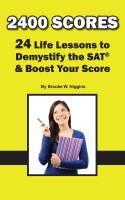
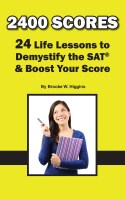
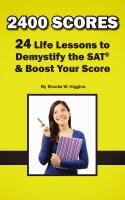
For more SAT tips, read 2400 SCORES by Brooke Higgins available at Amazon. Contact Brooke Higgins and CROSSWALK to schedule your private tutoring or Boot Camp for SAT, ACT and more. 

How to Sleep Your Way to a Better SAT Score

Stress kills on the SAT. 


My students hear me wax poetic that stressed brains do not learn as well as unstressed brains. In fact, one of my first lessons with my students demonstrates that attitude is more important than aptitude. Simply put, a student’s aptitude cannot shine when the student’s attitude is negative, tired, unfocused or stressed. 

While many of my conclusions are based in scientific research and years of instruction, I was recently blown away by a study about sleep and the SAT. 

According to authors Po Bronson and Ashley Merryman in the book NurtureShock, teens need to sleep longer in the morning than adults. Scientifically, an adolescent brain continues to release melatonin–a hormone that regulates sleep–until well after dawn. Adults, on the other hand, slow their release of melatonin as the sun rises. For this reason, teens shouldn’t be forced to wake up as early as adults. 

Bronson and Merryman cite a study done in a high school in Edina, MN. Testing the idea that teens should sleep longer in the morning, the high school changed its start time from 7:25 to 8:30 giving teens an extra hour of sleep. 

In the year prior to the change, the top 10% of Edina’s students averaged a math score of 683 and a verbal score of 605. A year after the change, the top 10% averaged a 739 on math and a 761 on verbal. In other words, math scores went up 56 points and verbal scores went up 156 points. Furthermore, the study also concluded that these students were more motivated and less depressed after the change. 

Astounding, no? By simply allowing teens to sleep longer, and letting their hormones do what they are supposed to do, test scores shot up and kid’s lives improved. 


So maybe letting Junior sleep a bit longer in the morning is actually a good thing?

Learn more SAT test-taking tips by reading 2400 SCORES” 24 Life Lessons to Demystify the SAT and Boost Your Score by Brooke Higgins. Contact CROSSWALK today to learn about SAT/ACT Boot Camps, private tutoring and other ways to improve your academic standing. 

Take Note: Laptop or Not?

While many agree that technology moves slowly in education–consider how little most classrooms have changed in the past century–some technology zooms. 


For example, the laptop. Now more than ever, students rely on laptops to write, access information and collaborate. Most importantly, students take notes in class knowing they can type faster than they can write. 

However, a new study suggests that taking notes on a laptop may not be the best way to comprehend and retain information. Instead, pen and paper help students remember better than a laptop. 

It seems that the act of writing things down helps cognition

Read the entire article here. 

So don’t use a laptop to take notes in class? Maybe those old classrooms had it all figured out in the first place. 

Learn more study habits with tutoring from CROSSWALK, the Monterey Peninsula’s local resource for private tutoring and SAT/ACT Prep. Read “2400 Scores: 24 Life Lessons to Demystify the SAT and Boost Your Score” by Brooke Higgins. 

What Will You Read This Summer?

Summer is fast approaching. Amazing how fast this school year came and went. 

With vacation around the corner, what will you be reading this summer? 

My students quickly learn that the SAT and the ACT are nothing more than reading tests. Don’t be misled by science or math sections. While the content may deal with science and math, these sections force you to analyze text, interpret information or translate words into an equation. In other words, they are just reading tests. 

So what is the best way to get ready for a reading test? That’s right, READ! Read, read, read and then read some more. 

You don’t have to take my word for it. I always say that active reading prepares your brain for success on the SAT and ACT, but a recent piece in the New York Times reminds us that reading will also touch your heart, spirit and soul

So with only weeks to go before summer starts, start now by figuring out what books you want to read over the next several months. The beauty of summer is that you can read whatever you want! Seriously! With no set assignments, there is no limit to what you can read. Obviously, the more challenging the reading, the more you may expand your vocabulary. But don’t let that deter you from grabbing any fun novel and diving in. 

Lose yourself in a book. Lose yourself in several books. Reading will not only help you get ready for the SAT and ACT, it will touch your soul will in ways that you cannot even imagine. 

Learn more study tips by contacting CROSSWALK, the Monterey Peninsula’s local resource for test prep and private tutoring. Read 2400 SCORES: 24 Life Lessons to Demystify the SAT and Boost Your Score by Brooke Higgins available for your e-reader at Amazon. 

How to Make Time for SAT/ACT Prep

Spring might be the busiest time of year for students. At this point in the year, students have lot on their plate what with upcoming final exams, team sport commitments, and end-of-year celebrations like prom or graduation. What’s worse, the warmer weather can prove to be a major distraction.  

With all of this going on, how can you possible have time for SAT or ACT Prep? 

One option is to avoid taking the SAT or ACT in the spring. Trying to cram in a test at a busy time of the year can be a recipe for disaster. For this reason, the spring months might be the worst months to take the test

However, it is possible to squeeze it all in with a little diligence and discipline

A diligent student will make test prep part of the normal routine. Making things a routine is a life skill that will help test preparation, as detailed in Score #1500 of 2400 SCORES: 24 Life Lessons to Demystify the SAT and Boost Your Score. Just like brushing your teeth, the more test prep becomes part of your regular routine, the easier it is to manage. 

While diligence will help you build a routine, you also need discipline to maintain it. One way to stay disciplined, is to save your dessert for last. Saving your dessert for last is another life skill detailed in 2400 SCORES: 24 Life Lessons to Demystify the SAT and Boost Your Score. The idea is that you delay the gratification of dessert until you eat all of your vegetables. In other words, postpone any fun things until after you finish your test prep. Doing test prep first and giving yourself a reward after will make you more productive and could make the fun things even more enjoyable. 

This is a crazy time of year. Finding time to prep for the SAT or ACT can be a challenge, but with some diligence to follow a routine and some discipline to delay gratification, you can squeeze it all in even during busy times.


Learn more about preparing for the ACT and SAT by contacting CROSSWALK, the Monterey Peninsula’s local resource for private tutoring, test prep and ACT/SAT Boot Camps. Read 2400 SCORES: 24 Life Lessons to Demystify the SAT and Boost Your Score by Brooke Higgins for more tips to get ready for test day. 

The More Things Change…

Just when you thought you had prepared all you could for the SAT, they had to go ahead and change it up on you. 


But don’t fret. The new changes to the SAT announced by the College Board won’t be put into effect until the spring of 2016. 

And truth be told, many of the changes to the SAT are not too drastic. It seems that the College Board simply wants to align its assessment closer to the work done in both high schools and colleges. 

If you haven’t read the overview of these SAT changes as originally announced in the New York Times, visit this article. For a more condensed version of the same information, here are the major changes coming in two years:

  • Scoring: the penalty for wrong answers is no longer and the score will be scaled out of 1600 like it was prior to 2005
  • Vocabulary: more emphasis will be placed on the vocabulary used in college courses as opposed to those uncommon albeit famous SAT words like “ascetic”
  • Essay: what was obligatory will now be optional
  • Math: content is streamlined to include linear equations, complex equations, functions, ratios, percents and proportions among others and no calculators will be allowed on the test
  • Reading: passages will include excerpts from famous historic texts, like the Declaration of Independence 
Yes, change is in the air and those in the Class of 2017 and beyond will want to take note. 

Get ready for the SAT and ACT with help from CROSSWALK. Boot Camps, private tutoring and study help are all ways that CROSSWALK can lead you on your path to learning success. 

SAT Prep Success Stories

Walt Whitman is credited with saying, “It you done it, it ain’t bragging.” 

With that in mind, I share some of our recent success stories at CROSSWALK. Both of these stories deal with SAT prep and both deal with private students at CROSSWALK

Walt Whitman


The first story is about a senior in high school taking the SAT for the last time. After doing little preparation before the first time he took the test, this student scored well on the math and critical reading sections. However, he faltered on the writing and was disappointed in his score of 560. 

After just four laser sessions with specific practice on writing, he raised his score to a 700. This is what the father sent us in an email: 

“He did well on his writing section–he increased his score from a 560 to a 700. Combined his SAT is now in the 2200+ range. He is awaiting answers from colleges. Thanks. Your tutor did well.” 

The second story is even more interesting. It is about a young woman who had already started in college but decided to transfer to another school. Tasked with taking the SAT again, she had a goal of increasing her score by 200 points. Making matters more difficult, she only had a couple of weeks to prepare for the exam so she crammed in four private sessions in just one week. 

Despite the challenges, the results were excellent. Her mother called us to share the following: 

“We are so happy. She increased her score by 250 points. You did a great job! Thanks so much. I wish we would have contacted you years ago!” 

So forgive the bragging, but someone has to toot CROSSWALK‘s horn. And after all, per Mr. Whitman, “if you done it, it ain’t bragging.” 

Brag about your score increase with private SAT and ACT prep, or an ACT or SAT Boot Camp from CROSSWALK. Contact us today to learn more. 


Download “2400 SCORES” from Amazon and learn 24 life skills to demystify the SAT and boost your score. 


You Are More Than a Test Score

One of my first lessons for my students is that you cannot stress about the SAT or ACT. Stress is not allowed on the test because your life represents more than just a test score. The more you get wrapped up in the score, the more you stress. And the more you stress, the worse you perform. 


Even the latest study by the National Association for College Admission Counseling points out that a student’s success in college has little or nothing to with the fact that he or she reported test scores to the university. 

In fact, this study implies that using standardized test scores as a predictor of college performance is not a reliable model. Students that submitted test scores to colleges finished their degrees with a trivial difference in both GPA and graduation rate as compared to students that did not submit test scores. 

Now, it would be premature to think that the sunset is upon the SAT and ACT. These tests remain major factors in the college application process. But since over 800 schools hardly use the ACT or SAT for admission decisions, the writing may be on the wall. 

The best advice, at this point, is to prepare for both the SAT and ACT as if they were games or puzzles to solve. Don’t let stress enter the equation. Keep your brain focused, fresh and flexible. Just because you may have to take the test doesn’t mean you should stress about it. 

If you remove the stress over achieving a perfect–or near perfect–score, then your performance will soar. 

Learn more test prep tips by reading 2400 Scores or by contacting CROSSWALK. CROSSWALK offers SAT/ACT Boot Camps, private tutoring in person or via Skype and other tools to prepare academically.

The Olympics of SAT and ACT Prep

Few things on television deliver goosebumps like the Olympics do. Politics aside, the stories of these elite athletes are as remarkable as their achievements. 

Undoubtedly, Olympic athletes have incredible skill. More importantly, they train hard. 10,000 Hours hard. 

What if you trained 10,000 hours for the SAT or ACT? How would you perform? 

I always find it curious when I come across students that call themselves bad test takers. As I talk to these students more, I find out that they play a musical instrument, practice a sport and/or maintain long term personal relationships. Basically, they are skilled in something that has required time, dedication and persistence. 

Test taking is a skill that can be learned through time, dedication and persistence. Even if you think you are a bad test taker

Not every athlete is going to win a medal at Sochi, and not every test taker is going to achieve a perfect score. But those that train hard to master a skill will be rewarded with achievement. 

The Olympians of Sochi are an inspiration to us all. They show us that it takes hard work to overcome obstacles, perfect a skill and accomplish goals. 

Achieve your test taking goals with help from CROSSWALK, the Monterey Peninsula’s resource for test prep and academic tutoring. Contact CROSSWALK for more information about Boot Camps, Skype sessions and other test prep services. Learn more SAT test prep tips by reading 2400 Scores

The #1 Reason SAT & ACT Essays Score Low

It’s a far too common story: students that frequently score A’s on their essays in school come up short on the SAT or ACT. Unfortunately, normally proficient writers can end up scoring lower than expected on test day. 

Why the difference? Why are so many students disappointed in their essay score on the SAT or ACT? 

It’s a simple answer: most essays miss the mark because they lack a clear thesis. A clear thesis is the most important element to scoring high on both the SAT and the ACT essay. 

While a clear thesis may be important on a school essay, it is paramount to a good score on the SAT and ACT. Without it, you can score no higher than a five out of a possible six, and in many cases not better than a four. 

Most baffling is how unmistakably easy it is to communicate a clear thesis. Both the SAT and the ACT offer a question in which the writer must pick a side. Test scorers could care less which side you take as long as you take a side. 

Score higher by stating only one side of the argument. Make it patently obvious which side you take. The easy route is to answer the prompt in the positive or the negative, whichever will be the argument you develop in your essay. You don’t need a catchy opening as some people might suggest. Just spell out your main point and hit the reader over the head by repeating it throughout the essay. After reading your essay, there should be no mistake as to your perspective on the issue. 

Sounds simple, and it really is. Unfortunately, even the best writers get lost in their own prose. Avoid a low score on your essay by making a clear point and sticking with it. 

Learn more test tips by reading “2400 SCORES: 24 Life Lessons to Demystify the SAT® and Boost Your Score” by Brooke Higgins available at Amazon

Contact CROSSWALK to learn about SAT and ACT Boot Camps, private test prep and academic tutoring for all subjects on the Monterey Peninsula.